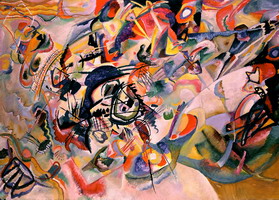
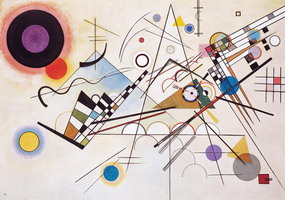
Compositions
Kandinsky considered his Compositions as main statements of his artistic ideas. They have a number of characteristics expressing this monumentality: impressively large size, conscious planning of composition, and a transcendent quality achieved through the development of an abstract image. Just as symphonies are milestones in the career of a composer, Kandinsky's compositions represent the culmination of his artistic vision at every moment of his creative career."From the very outset," the artist wrote, "that one word "composition" sounded to me like a prayer." The first composition dates to 1910, the last one to 1939. Thus, the Compositions are a common thread running through the entirety of Kandinsky's oeuvre, from his first steps toward abstraction to the last "biomorphic" Paris period. Unfortunately, the first three compositions were destroyed during the Second World War, and only their photographs survived.