

Orphism
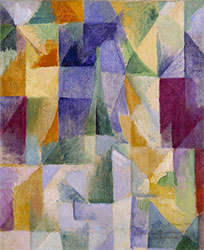

Orphism, which became one of the key movements of early abstract art, emerged from Cubism as an impulse to abandon visual games with geometry and to focus exclusively on color and form. It is based on law of simultaneous color contrast, whereby the perception of a color changes depending on the hues surrounding it, while the intersection of dynamic forms creates a sense of movement and rhythm.
The term, coined by the poet Guillaume Apollinaire in 1912, was a reference to the ancient Greek Orpheus, who could work miracles with the music of his lyre. Apollinaire apparently had in mind the miracle of the Orphists creating an entirely new world — one that had never existed before. However, one of the founders of Orphism, Robert Delaunay, himself described his painting as "simultaneous" and drew directly from precise scientific research.
In the context of art, the term "simultanism" refers to the coexistence of different artistic or narrative aspects within a single work. This can be seen, for instance, in the combination of frontal and profile views in ancient Egyptian art, the conflation of multiple temporal moments in medieval painting, or — in the case of Orphism — the simultaneity of perceiving color contrasts.
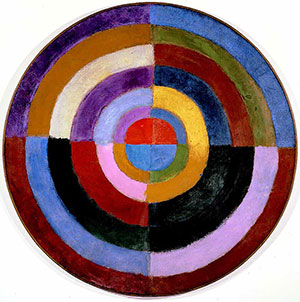
Robert Delaunay drew on the treatise of the French chemist Michel Chevreul, The Law of Simultaneous Contrast of Colors (1839), in which Chevreul substantiated the principles of perceiving color combinations determined by the physiology of human vision. Notably, long before the Orphists, Chevreul's findings were actively applied by the Post-Impressionists: they supplemented the traditional mixing of pigments on the palette with optical mixing (in the eye of the viewer) which became another groundbreaking stage in painting, though one that developed within the framework of figuration.
Delaunay, for his part, proclaimed that "color alone is both form and subject," and although in his early Orphist paintings objects are still recognizable, by 1912–1913 he had moved to a purely abstract language, where form serves exclusively as a dynamic and rhythmic vehicle.
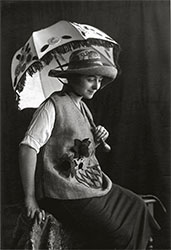
Sonia Delaunay, wife and artistic partner of Robert Delaunay, who stood alongside her husband at the origins of Orphism, did not confine her work to the canvas — she applied the new artistic language to fashion, design, and decoration, channeling Orphism directly into everyday life. Her "simultaneous" dresses, textile patterns, and interior design items achieved widespread success across Europe.
In Madrid, where the couple relocated at the outbreak of World War I, Sonia Delaunay opened the renowned fashion and interior boutique Casa Sonia. In 1918, she designed costumes for Diaghilev's legendary ballet Cleopatra, and upon returning to Paris in 1920, she founded the Atelier Simultané. Following Robert Delaunay's death in 1941, while continuing to advance her own "applied" Orphism, she assumed the mission of preserving and promoting her husband’s artistic legacy.
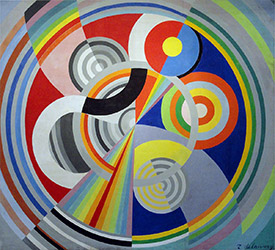
When Apollinaire, inspired by the new language of color, first uttered the word "Orphism," he associated it not only with Robert Delaunay but also with several other artists: František Kupka, Francis Picabia, Fernand Léger, Marcel Duchamp, and Jean Metzinger. However, none of them identified as Orphists, and only the Delaunays consistently advanced these "simultaneous" ideas — which made Orphism one of the most significant movements of early abstraction.