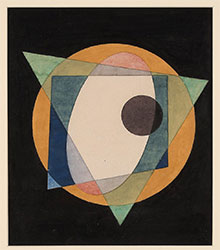
Suprematism
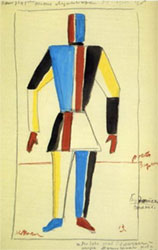

On December 3 and 5, 1913, the Cubo-Futurist opera Victory over the Sun premiered at the Union of Youth Theatre in St. Petersburg, with Kazimir Malevich designing its scenography. It was then that the artist began to find the syntax of a new language: the actors' costumes were rigid geometric structures, and the stage designs for one of the scenes featured a square diagonally divided into black and white, symbolizing the struggle of "active human art" against the "passive form of nature."
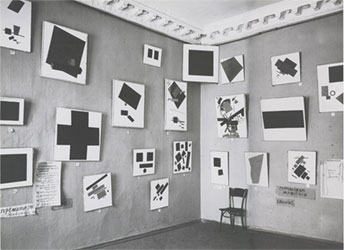
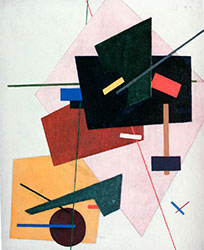
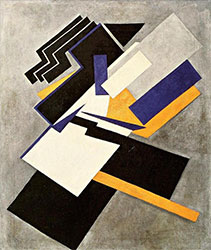
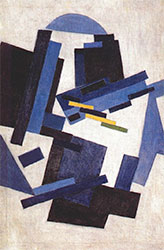
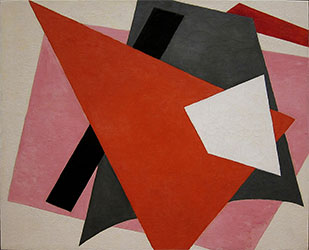
The birth of Suprematism came with the Last Futurist Exhibition of Paintings "0.10". (Petrograd, 1915), which proclaimed the end of Futurism and presented a radically new visual language to a shocked public. From floor to ceiling, the walls were hung chaotically with minimalist paintings featuring geometric primitives in primary colors, while Tatlin's abstract sculptures were installed in the corners, and Malevich's Black Square occupied the traditional place of Orthodox icons in the "red corner." The exhibition drew a wave of criticism from artistic circles; nevertheless, following it, many avant-garde artists joined the new movement, and exhibitions became regular — both in Petrograd and Moscow. To debate ideas and exchange views, Malevich organized the Supremus society and founded an eponymous journal (which, unfortunately, was never published). Moreover, the Suprematists joined the authoritative Moscow association Jack of Diamonds, quickly becoming its main driving force, which culminated in Malevich leading the group as its chairman in 1917.

In 1919, Malevich accepted a teaching position at the Vitebsk People’s Art School, where within a couple of years he captivated everyone with his ideas and virtually rebuilt it along new lines. The school, originally conceived by Marc Chagall as an open academy for diverse styles, was transformed into a center of Suprematism where Malevich's students and associates — El Lissitzky, Ilya Chashnik, Nikolai Suetin, Lazar Khidekel, and others — rallied around him. Members of the newly formed collective, UNOVIS (Utverditeli NOVogo ISkusstva — "Affirmers of the New Art"), inspired by the unfolding opportunities, staged a large-scale urban experiment. They used Suprematist imagery everywhere: painting building facades, trams, and rally podiums, organizing lectures, staging theatrical performances, and publishing newspapers. For a few years, Vitebsk became the "capital of Suprematism." Paradoxically, all of this unfolded against a backdrop of devastation, famine, and the Civil War raging across the country.

In the preface to the album Suprematism: 34 Drawings, which combined theory with a visual aid, Malevich defined the place of Suprematism not only within art but within the system of the world order as a whole. In this manifesto, presented in the form of a philosophical essay, the author wrote that his three squares — black, red, and white — were no longer painting, but "the establishment of certain worldviews... black as a sign of economy, red as a signal of revolution, and white as pure action".
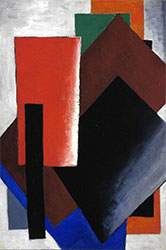
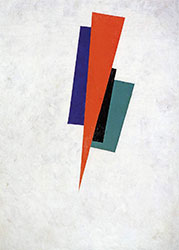
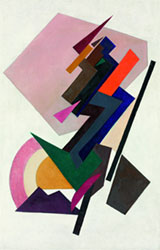
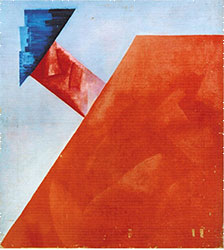
Beginning with the shock value of the 0.10 exhibition, Suprematism grew in just five years into a powerful movement with a serious theoretical foundation and broad practical application; however, with the rise of Stalinism, the state began to systematically restrict freedom of artistic expression. Soviet art moved toward Socialist Realism, while all "unfitting" movements were gradually banned. By the late 1920s, Malevich's Black Square — having journeyed from a symbol of man's struggle against nature to a new icon — shrank to the size of a signature in the corner of his figurative paintings. However, the Suprematist legacy, embraced by Western artists, influenced many of the newest movements in abstract art. We still encounter it everywhere today — in t-shirt prints, signboard design, architectural elements, and interface fonts.