

Abstract Art: Key Movements & Artists
Abstract Art is a distinct artistic reality in which creators renounced the depiction of the surrounding world in favor of non-objectivity — the language of pure forms, lines, and color. Instead of illustration, imagery, or symbolism, abstraction appeals to pure perception. This was not merely another style, but a radical reconsideration of the figurative tradition, breaking its monopoly in art. Liberated, abstract art began to branch out into a spectrum of independent trajectories, each offering its own vision of non-objectivity.
- The Birth of Abstraction
- Manifestos (Rayonism, Suprematism and Neoplasticism)
- The Study of Forms (Geometric, Concrete and Biomorphic Art)
- Post-War Experiments (Abstract Expressionism and Tachisme)
- Neo-Avant-Garde (Hard-Edge, Op Art and Minimalism)
- Postmodernism (Neo-Geo, Digital Abstraction and Zombie Formalism)
The birth of abstraction
At the turn of the 20th century, a need arose in painting to break through the boundaries of figuration. Artists began to ask themselves: how can one depict what cannot be seen, for instance, the music of a violin, the feeling of nostalgia, or the freshness after rain? Is art even capable of conveying the full complexity and diversity of the world? The invention of photography played a significant role, as it could capture reality more accurately and quickly. New scientific discoveries also had an impact: if, as Einstein proved, even time is relative, then where is one to look for a stable reference point?
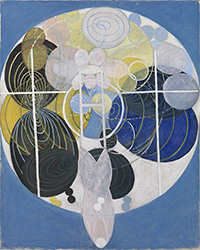

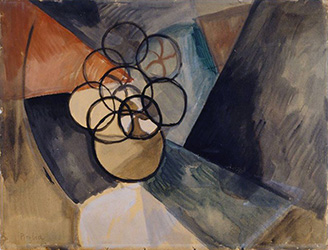

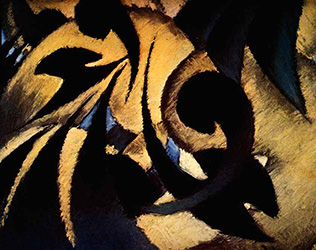


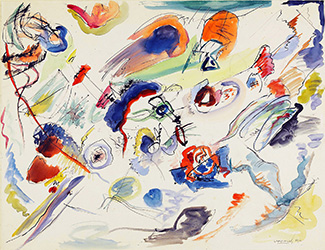
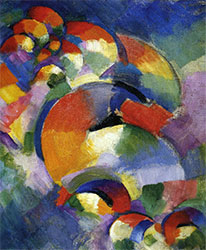
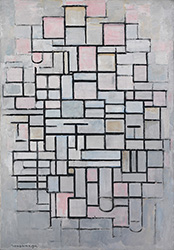
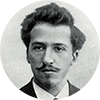
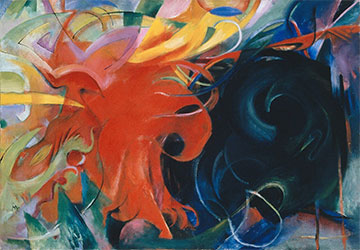
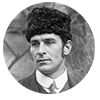

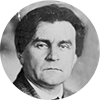

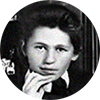
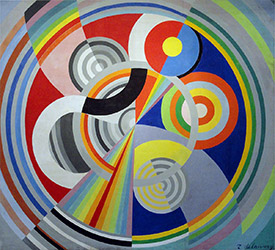
Attempts to answer such questions can be seen in the work of many early 20th-century artists — and each of them arrived at abstraction in their own way. Hilma af Klint was inspired by theology and spiritualism — she participated in séances and heard voices from above, guiding her. Arthur Dove developed his concept of 'extracting' the essence of objects and transforming them into abstract forms on canvas. The founders of Orphism, Robert and Sonia Delaunay proclaimed that 'color alone is both form and subject' and focused on the pursuit of 'simultaneous' color contrasts. Kazimir Malevich manifested 'the supremacy of pure artistic feeling' over figurative depiction and experimented radically with geometry. Wassily Kandinsky, however, built his abstract approach on a solid theoretical foundation of his own.
Manifestos: Rayonism, Suprematism and Neoplasticism

In 1913, Mikhail Larionov published the theoretical booklet Luchizm, in which, building upon the evolution of the latest trends in painting, he outlined the prerequisites for the emergence of a new visual language — Rayonism. The core concept of the movement was based on a physical fact: the human eye does not perceive objects themselves, but the light (rays) reflected from them. Therefore, in order to convey authentic visual reality, the artist should depict not physical entities, but the rays reflected by them, as well as all other rays entering the field of vision. "The picture appears to be gliding, it gives a sensation of the timeless and spatial." Just a year after the publication of the first manifesto, the development of Rayonism was cut short by World War I; nevertheless, it remains a vivid chapter of early abstraction.
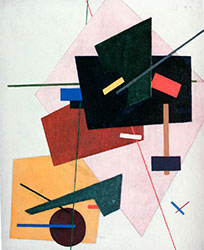
Also in Russia, Kazimir Malevich painted his most famous work, Black Square (1915), representing the simplest form of black, an extreme simplification—in fact, the zeroing of painting. That same year, he created a red square, ironically named Painterly Realism of a Peasant Woman in Two Dimensions, and three years later, concluding this sacred Trinity, he executed a white square on a white ground — an emblem of erasing boundaries. In his 1920 essay Suprematism, he emphasized that these were not just three pictures, but a conceptual evolution of worldview: "black as a sign of economy, red as a signal of revolution, and white as pure action." The Suprematists did not merely paint pictures and write manifestos — they declared themselves the creators of a new world order, having resolutely broken all ties with the academic tradition and introduced their ideas into every sphere of life — from the design of porcelain cups to architecture.





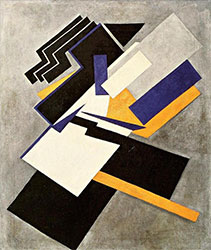
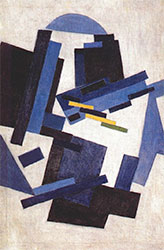
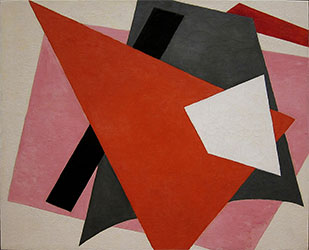
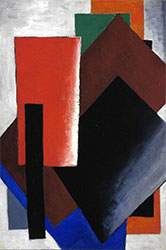
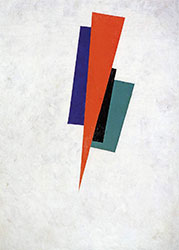
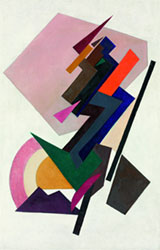
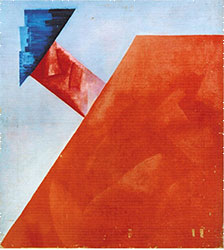
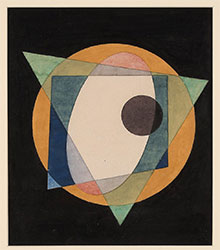


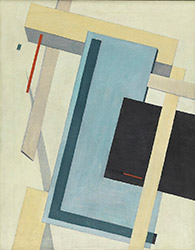

Interestingly, it was the Suprematists who managed to connect abstract art with architecture. Constructivism served as the bridge, and the connecting link was El Lissitzky's concept of PROUNs. Lissitzky, a student of Kazimir Malevich, described his system as a "transfer station on the way to architecture." PROUN (a Russian acronym for "PROekt Utverzhdeniya Novogo", meaning "Project for the Affirmation of the New") is a Suprematist composition where elements begin to take on volume.
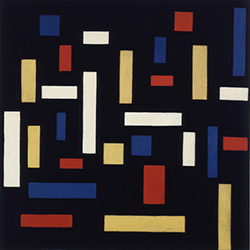
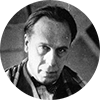
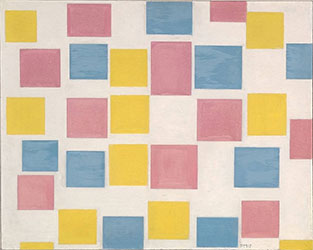
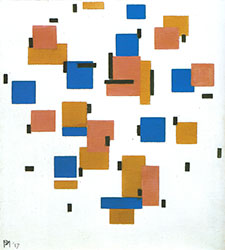
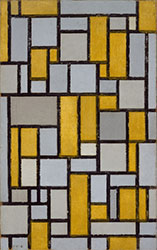
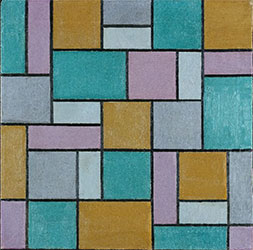
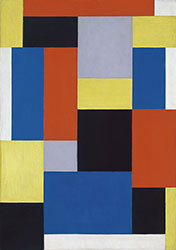
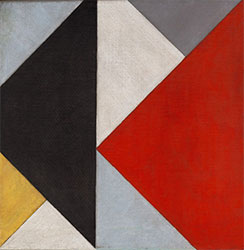
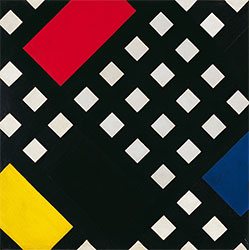
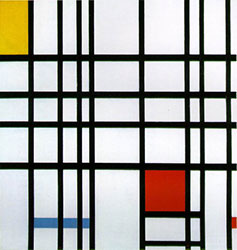
A parallel movement was unfolding in the Netherlands, Neoplasticism, which sought to reflect universal harmony and balance in painting. In terms of pictorial means, Neoplasticism went even further than Suprematism: lines are exclusively horizontal and vertical, the palette is limited to pure primary colors (or their absence), and the canvas is organized with balanced proportions and a sense of ideal order. The main figures of the movement were the Dutch artists Theo van Doesburg and Piet Mondrian. Piet Mondrian drew on theosophical ideas of the unity of the universe through the duality of the spiritual and the material. For him, the vertical axis symbolized the active and spiritual principle, the horizontal — the passive and earthly, and their intersection generates a "universal equilibrium." Theo van Doesburg, in turn, was not only an artist and theorist but also the driving force behind the new movement: in 1917, he founded the journal De Stijl and gathered a group of like-minded artists around it. In 1924–1925, he decided to introduce diagonal lines into his paintings to symbolize dynamism — a decision that led to his break with Mondrian.


The study of forms: Geometric Abstraction, Concrete Art, Biomorphic Abstraction
Geometric abstraction, which began with the radicalism of Suprematism and Neoplasticism, evolved into a universal artistic method during the interwar period and became firmly established in the practices of the Bauhaus, Abstraction-Création, Cercle et Carré, and others. Leaning toward rationalism and logic, it operates with pure colors, straight lines, and precise geometric forms.
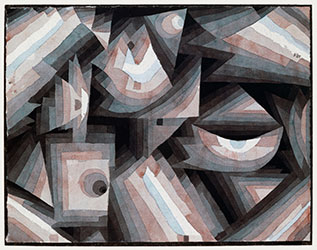
At the Bauhaus, a rigorous scientific approach prevailed: Kandinsky taught color theory and sought universal synesthetic laws connecting color and form. For instance, he associated the yellow triangle with dynamism, the red square with stability, and the blue circle with spiritual depth. Paul Klee led a course on the theory of form — he explored the dynamic potential of form and the laws of visual movement. For him, "a line is a dot that went for a walk." In the Abstraction-Création association, which numbered over 400 artists, an atmosphere of experimentation prevailed, and creative freedom was encouraged in all its manifestations — from the mathematics of Concrete Art to the three-dimensionality of Constructivism. In Cercle et Carré, pure geometry was proclaimed the highest form of intellectual and spiritual discipline: Mondrian and Seuphor contrasted it with the irrationality of the increasingly popular Surrealism.
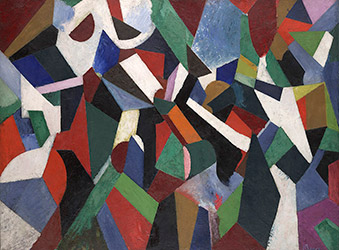


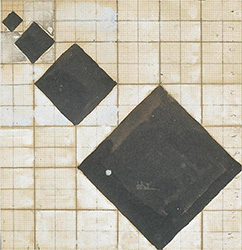

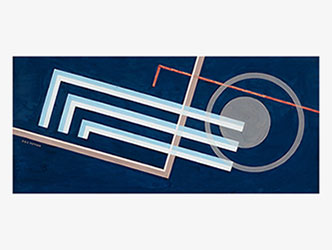
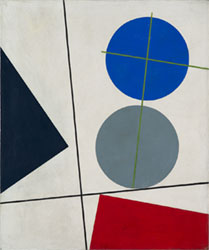
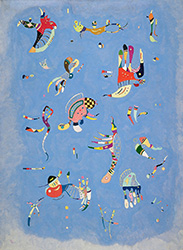
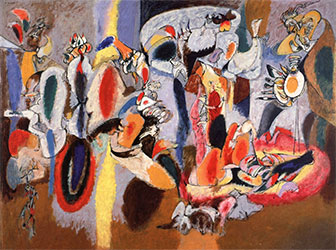
In 1930, Theo van Doesburg proposed replacing the term "abstract" with "concrete," arguing that abstraction carries negative connotations by rejecting reality, while concrete art is reality itself. He conceived the idea of bringing together a group of like-minded artists who would work in the direction of concrete art and promote it. The group released the journal Art Concret, which consisted of a single issue, outlining the principles of the new movement: complete rational control over the creative process, purely plastic elements, a mechanical, anti-expressionist technique, and absolute clarity.
Biomorphic Abstraction emerged as a response to strict geometry, drawing inspiration from living natural motifs — waves, the curves of branches, the spirals of microorganisms, and, of course, the contours of the human body. Free-flowing, fluid lines evoked an elusive recognizability of forms, lending such art a completely new, living dimension. In pursuit of these forms, some artists turned to Surrealist techniques, tapping into the wellspring of the unconscious (Joan Miró, Yves Tanguy, Arshile Gorky); others — such as Kandinsky in his late period and Paul Klee — found support in science, philosophy, and their own theoretical explorations. Moreover, biomorphism naturally extended into sculpture, where organic plasticity was embodied in physical volume (Jean Arp, Henry Moore, Barbara Hepworth).
From this point on, most of the key works discussed are protected by copyright law. For those who wish to see them, links will be provided. The illustrations in this section have been chosen from works that are freely available.
Post-war experiments: Abstract Expressionism, Tachisme, Lyrical Abstraction, Color Field Painting
After World War II, the art world was in a state of confusion and fear. What humanity had revealed itself capable of shattered the ideals that had been built over centuries. It was unclear where art was to go next — or whether it even needed to. The first reaction was rejection. The cold intellectual constructs of geometric abstraction gave way to expression and the spontaneity of pure action.
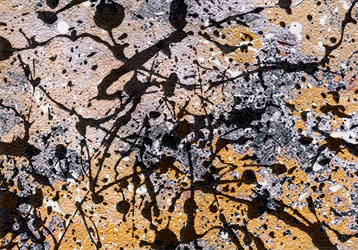
Jackson Pollock - "One: Number 31" (1950); Willem de Kooning - "Gotham News" (1955); Franz Kline - "Chief" (1950).
Meanwhile, in post-war France, the Art Informel movement was emerging, literally, "art without form." Like Abstract Expressionism, it rejected logical approaches and embraced the instinctive and the subconscious. Yet, perhaps because Europe's trauma ran deeper, the movement was, on an ideological level, far more radical.
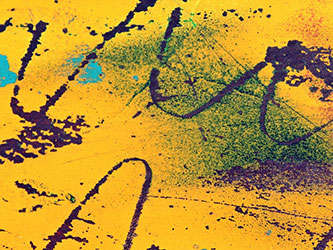
Hans Hartung - "L 116" (1963); Georges Mathieu - "Théorème d’Alexandroff" (1955); Pierre Soulages - "Peinture 202 x 143 cm, 21 septembre 1967" (1967).
An alternative wing emerged within the New York School — Color Field Painting. Its proponents rejected the expressive, gestural brushwork in favor of an analytical engagement with pure color. Mark Rothko filled his canvases with large rectangles of color, distinguished by the subtlest tonal transitions.

Mark Rothko - "Untitled (Red, Orange)" (1968); Helen Frankenthaler - "Flood" (1967); Barnett Newman - "Vir Heroicus Sublimis" (1950-1951), and Clyfford Still - "1957-D-No. 1" (1957).
Neo-Avant-Garde: Hard-edge painting, Op Art, Minimalism, American Lyrical Abstraction
By the early 1950s, world art had turned back to the legacy of the pre-war avant-garde of the 1920s, reinterpreting its achievements in the context of a new era. Constructivism, Suprematism, and the Bauhaus returned — but now in a world of spaceflight, mass production, and technological optimism. Several explanations have been offered for this shift: some scholars point to fatigue with the overwhelming emotionalism of Abstract Expressionism; others, to the unresolved potential of the 1920s avant-garde, cut short by the war. There is even a theory of the return of repressed trauma, breaking through into art in the form of the Neo-Avant-Garde.
In the early 1960s, a new movement emerged in American abstract art — Hard-edge painting, marking a return to geometric roots, radically simplifying forms and their interplay on the canvas. Flat, even shapes, filled with pure, vibrant colors, do not merge into one another here; they are clearly separated and bordered by hard defined lines.
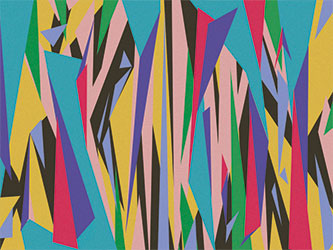
Frank Stella - Hyena Stomp (1962); Karl Benjamin - #30 (1969); Lorser Feitelson - Hardedge Line Painting (1963); John McLaughlin - Untitled (1960).
Op Art, or optical art, manipulates the peculiarities of human perception. The artists of this movement did not so much paint as construct their pictures: through carefully arranged black-and-white or colored stripes and shapes, they created the illusion of pulsation, movement, or rotation in the viewer.
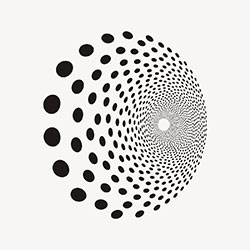
Another key figure of Op Art — Bridget Riley, whose work belongs to the 1960s — worked more intuitively and empirically, creating organic, wave-like compositions with powerful optical effects.
Victor Vasarely - Vega-Köntösh (1971); Bridget Riley - Movement in Squares (1961); Jesús Rafael Soto - Vibration (1960).
Minimalism, which emerged in the United States in the late 1950s, became a new conceptual and visual boundary of abstraction. Minimalization was not so much about reducing the number of objects as it was about eliminating (as far as possible in art) authorial presence.
Donald Judd - Untitled (Stack) (1967); Agnes Martin - The Tree (1964); Frank Stella - Die Fahne Hoch! (1967); Dan Flavin - Monument to V. Tatlin (1966).
Early abstraction by Wassily Kandinsky and Paul Klee, European Lyrical Abstraction and Art Informel of the 1940s–1950s, and American Lyrical Abstraction of the 1960s–1970s — the lyrical, that is, personal, emotional, and sensual approach has always been felt as a return to origins.
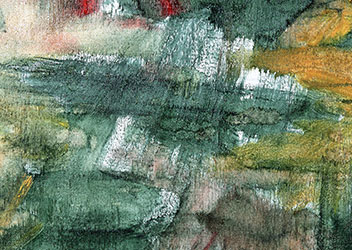
Ronnie Landfield - Diamond Lake (1969); Dan Christensen - Satan's Fury (1972); Pat Lipsky- Spiked Red (1969); John Seery - East (1973); Sam Francis - White Painting (1951).
Postmodernism: Neo-Geo, Data Abstraction / Information Mapping, Digital Abstraction / Glitch Art, Zombie Formalism
By the 1980s, faith in the ideals of Modernism had utterly vanished. The loss of illusions about humankind's humanity, disappointment in progress, and bewilderment in the face of new challenges — the cult of consumerism, the political impotence of society, and ecological anxiety — all demanded a new language from art. Yet artists did not invent this language from scratch; instead, they turned to cultural heritage and reinterpreted it through appropriation, irony, and play. The artistic toolkit expanded with new practices—conceptuality, performativity, intertextuality. Meanings were reformatted: art no longer sought to be avant-garde or engage in ideological battles; it mocked and parodied, but was not afraid to appear ridiculous itself; it broke down the barriers between high and low culture, readily borrowing from pop culture. As the boundaries between styles blurred, art merged into a single fluid landscape; nevertheless, within this field, several distinct trajectories of abstract art can still be mapped out.
The Neo-Geo movement (Neo-Geometric Conceptualism) turned to the geometric abstraction of the 1960s — Hard-edge and Minimalism — infusing it with new meaning inspired by Jean Baudrillard's ideas on simulacra and Michel Foucault's theories of disciplinary mechanisms.
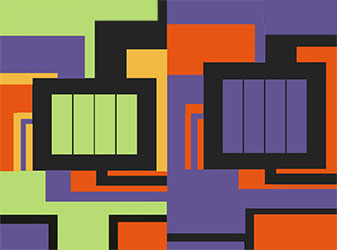
Peter Halley - The Waning of Affect (1993); Ashley Bickerton - Stratified Landscape #1 (1989); Philip Taaffe - Passionale per Circulum Anni (1993–1994); Meyer Vaisman - Filler (1986).
By the late 1990s, artists had come to realize that the geometric "cells and conduits" of Peter Halley were no longer sufficient. The world had turned into chaotic information maps, where symbols, text, diagrams, charts, and codes intersect and layer upon one another.
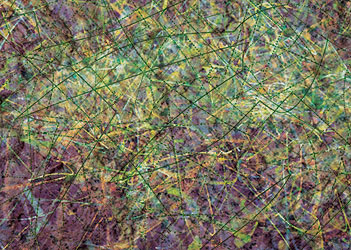
Julie Mehretu - Stadia I (2004); Franz Ackermann - Untitled (Mental Map: Peak Season) (2003); Mark Bradford - Constitution (2013).
Digital Abstraction / Glitch Art is a movement that transforms a software error or technical malfunction into autonomous aesthetic elements, engaging with the categories of disruption, fragmentation, and loss of control.
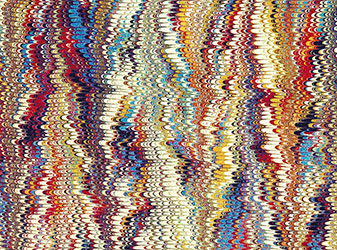
Nam June Paik - Magnet TV (1965); Albert Oehlen - Computer Paintings (1990s); Kim Asendorf - Pixel Sorting Algorithm (2010); Rosa Menkman - A Vernacular of File Formats (2010).
In April 2014, the prominent New York art critic Walter Robinson published an essay on Artspace titled Flipping and the Rise of Zombie Formalism. In it, he offered a scathing critique of a high-profile 2010s movement that united key figures of the new wave known as ‘process-based formalism’.
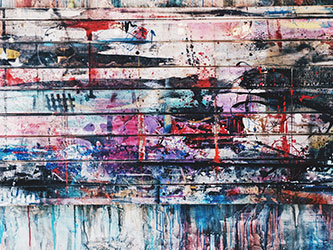
Lucien Smith - Two sides of the same coin (2012); Jacob Kassay - Untitled (2013); Oscar Murillo - 7+ (2013-2014).
Today, abstract art abandons the strict frameworks of movements and manifestos. The very notion of any fixed movement has ceased to exist; art has become a single, living current where everything blends, dissolves, and multiplies. Functions, practices, and values themselves become the subjects, forming a new meta-language. The integration of AI blurs the boundaries between the artist and the code. Abstract art, which began with a refusal to depict reality, now calls for rethinking — because reality itself is increasingly refusing itself.