

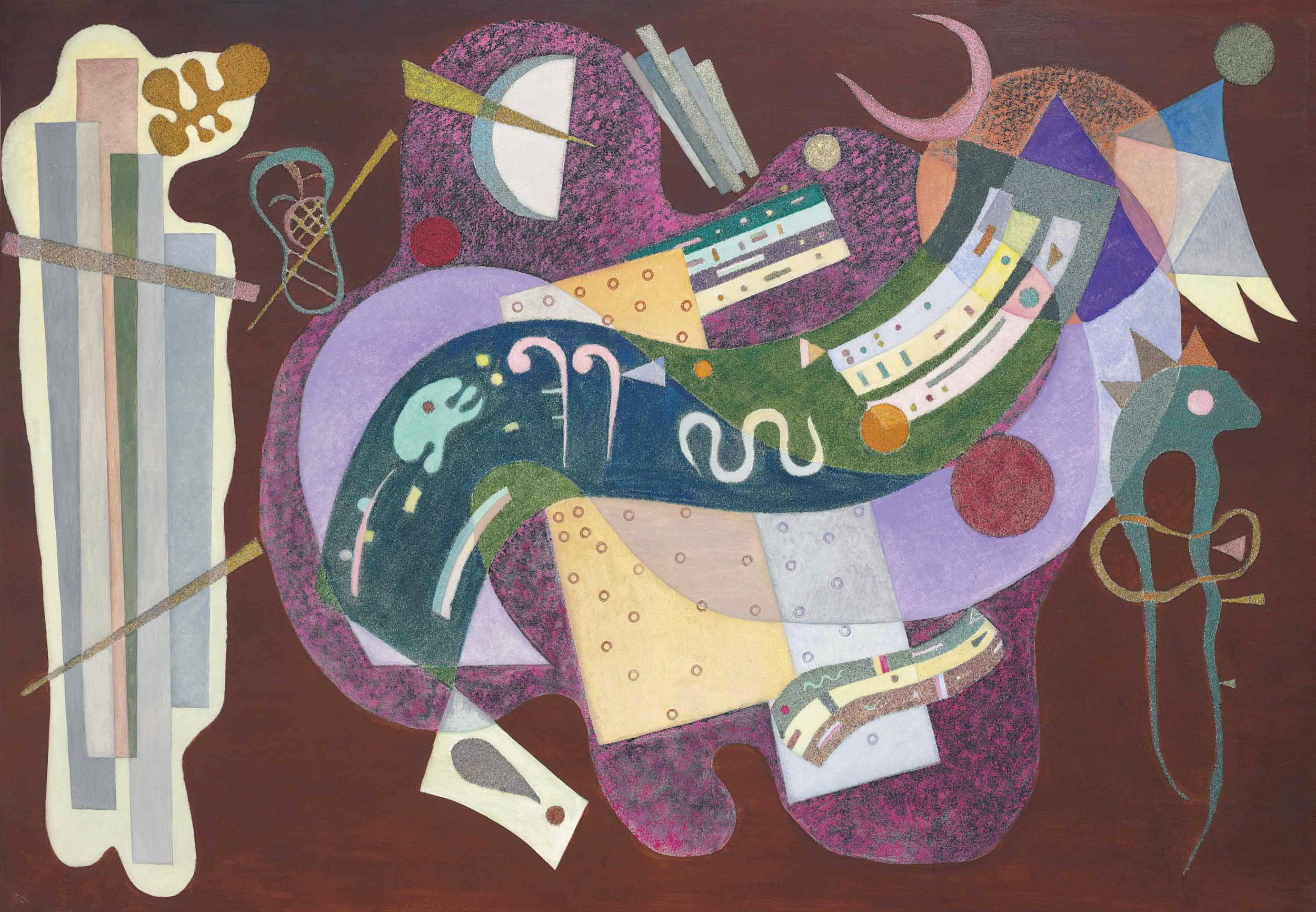
Rigid and Curved
Rigide et courbé
1935
Biomorphic abstraction
Oil on canvas
44.9 × 63" (114.0 × 160.0 cm)
Private collection
This work belongs to the late period of Kandinsky's art — the phase of Biomorphic Abstraction, also known as his Paris period. The famous collector Solomon R. Guggenheim bought it directly from the painter in 1936. The painting became part of his extensive collection and was exhibited several times, mainly in the United States. In 1964, however, the Guggenheim Museum decided to sell fifty paintings by Kandinsky at once, sparking protests from American art lovers. As a result, twenty-six paintings were purchased by European museums and collectors and removed from the United States. Rigide et Courbé was bought by an anonymous American collector. Half a century later, the painting returned to the market. On 16 November 2016, Rigide et Courbé was sold at Christie's, New York, for $23.3 million.
A careful examination of this painting — like many of Kandinsky's abstract works — may reveal quite realistic elements. On the left side, for example, we see a group of linked vertical forms, which may be a reference to the famous Nazi symbol, a highly topical subject at the time. A clear exclamation mark at the bottom and horn-like forms on the right also catch the eye. Some critics interpret the horns as an allusion to the myth of the Rape of Europa.
It is also interesting that in this work Kandinsky mixed sand into the paint to achieve a textured effect — a technique he had never used before.
A careful examination of this painting — like many of Kandinsky's abstract works — may reveal quite realistic elements. On the left side, for example, we see a group of linked vertical forms, which may be a reference to the famous Nazi symbol, a highly topical subject at the time. A clear exclamation mark at the bottom and horn-like forms on the right also catch the eye. Some critics interpret the horns as an allusion to the myth of the Rape of Europa.
It is also interesting that in this work Kandinsky mixed sand into the paint to achieve a textured effect — a technique he had never used before.
1 comments
2016
November 04
James Markham from Nyc: Very interesting story. My family owned and auctioned a Kandinsky Landscape with Church 1 (1909).
My grandfather bought it from Katherine Kuh in her private art gallery in Chicago in 1935 for $350.
My family auctioned it at Christies in 1987 for $2.4 million
Michael Findlay was in charge of our sale.
James Markham
Your comment
More from 1935


More from Private collection


