

Alexej von Jawlensky
1864 – 1941
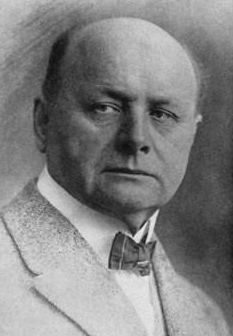
Alexej von Jawlensky was born on March 13, 1864, in Torzhok, Tver Province, and lived in Moscow from the age of ten. He began a military career and became interested in painting at the age of fifteen or sixteen. In 1889, already an officer in the Russian army, he requested a transfer to St. Petersburg, where he could combine military service with his studies, and entered the Academy of Fine Arts. There, the artist became a student of Ilya Repin and met Marianne von Werefkin, who, seeing a special gift in him, concentrated all her efforts on his development. In 1896, he left military service and moved with Marianne and her maid, Elena Neznakomova, to Munich to pursue his art education in Europe. In Munich, Jawlensky enrolled in the Anton Ažbe School, popular among Russian artists, where he studied with Wassily Kandinsky.
The artist admired Van Gogh, Cézanne, and Matisse; he absorbed all the latest European painting trends and developed his own style, characterized by the bold use of bright, pure color. Thanks to Sergei Diaghilev, he exhibited several of his works at the Autumn Salon in Paris. The artist was popular, and his paintings sold well.
He and Marianne spent the summer of 1908 together with Kandinsky and Münter, and this short-lived but very fruitful creative union became the foundation of the New Association of Artists (Neue Künstlervereinigung München, or NKVM), which began its activities in January 1909. Jawlensky was also a member of the Blue Rider (Der Blaue Reiter), founded in 1911 by Kandinsky and his associates.
With the outbreak of World War I, the artist moved to Switzerland with Marianne, Elena, and Andrey (officially his nephew but in reality his son by Elena), where he lived in Saint-Prex on the shores of Lake Geneva. A period of crisis ensued, compounded by financial hardships, wartime instability, and the inability to return to their relatives in Russia. The artist could not paint in his old "Munich" style and sought new ways of self-expression. His style was transformed toward a partial rejection of figuration and a simplification of forms.
In 1916, he met the German artist Emmy Scheyer, who, like Marianne twenty years earlier, was inspired by his work and served as his secretary and art dealer. This marked the beginning of a major creative phase in the artist's life began: moving to Zurich, the center of cultural life, brought new ideas, a new style, numerous exhibitions, and finally, well-deserved recognition.
"I realized that an artist in his art should use forms and colors to speak of the divine in himself. Therefore, a work of art is a visible God, and art is a 'longing for God.'"
In 1921, Jawlensky separated from Marianne and moved to Wiesbaden, where he married Elena Neznakomova the following year. In Germany, thanks to the efforts of Emmy Scheyer, his career reached new heights. Jawlensky, along with Kandinsky, Klee, and Feininger, became part of the "Blue Four" (Die Blaue Vier) group, which gained widespread recognition in the United States during an exhibition tour.
The artist's final years were marred by a serious illness—arthritis—which forced him to completely abandon painting. However, he managed to complete his deeply spiritual "Meditations" series. Alexej von Jawlensky died on March 15, 1941, in Wiesbaden.
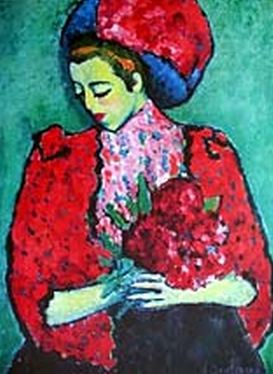
Young Woman with Peonies, 1909
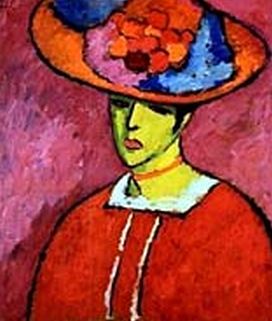
Schokko, 1910
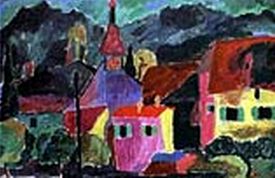
Village of Saint-Prex, 1916

Mystical Head, 1917
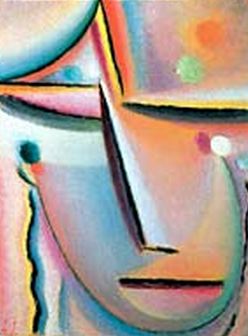
Abstract Head, 1922
