Lake
See
1910
Oil on canvas
38.6 × 41.3" (98.0 × 105.0 cm)
Moscow, The State Tretyakov Gallery
Kandinsky's artistic career was closely linked to Germany, where he had lived for extended periods before finally leaving Russia. In the late 1900s, the artist lived in Murnau, near Munich, where he worked extensively and made sketches from nature. At that time he followed the ideas of Expressionism — not so much in terms of the drama of life, which was the movement's main theme, but rather in his approach to form.
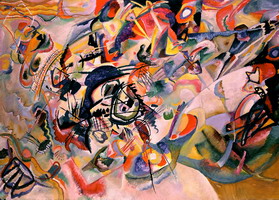
Kandinsky believed that "a subject (something real: man, tree, cloud) is just a kind of real flavor, side tone, and fragrance in the composition," so there was no need for its exact reproduction. Painting affects human consciousness through color and form. The artist understood form as a distribution of planes and lines, the balance of which expresses movement. Color carries the main burden — not only in the emotional coloring of the work, but also in the very construction of the composition. Form, meanwhile, either retains its subject outlines or loses them, as in the painting Lake.
Kandinsky believed that "a subject (something real: man, tree, cloud) is just a kind of real flavor, side tone, and fragrance in the composition," so there was no need for its exact reproduction. Painting affects human consciousness through color and form. The artist understood form as a distribution of planes and lines, the balance of which expresses movement. Color carries the main burden — not only in the emotional coloring of the work, but also in the very construction of the composition. Form, meanwhile, either retains its subject outlines or loses them, as in the painting Lake.
Be the first to comment
More from 1910


More from Moscow, The State Tretyakov Gallery