

Will Grohmann
1887 – 1968
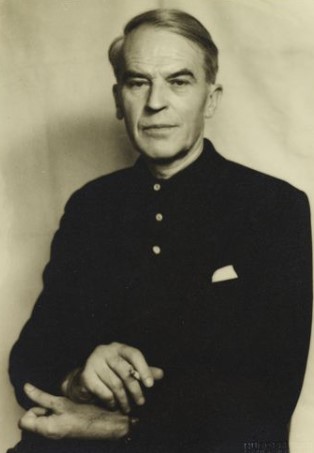
From 1908 to 1913, Grohmann studied Oriental languages at the universities of Paris and Leipzig, with a special focus on Sanskrit. He wrote his doctoral thesis on German literature and taught languages at a school.
But his true passion was art—he devoted himself entirely to art research and publishing. He was interested in the artists of the Die Brücke group and actively supported the Bauhaus school. After the First World War, he wrote many articles for Thieme-Becker, a German biographical directory of visual artists. He published a book on Kirchner and was friends with Otto Dix, Paul Klee, Wassily Kandinsky, Oskar Schlemmer, and many others.
From 1926 to 1933, Grohmann worked at the State Painting Gallery in Dresden. In 1933, the Nazis dismissed him for his support of modern art. Nevertheless, he continued to publish articles under the pseudonym Olaf Rydberg. During World War II, he explored the safer fields of archaeology and Migration Period art.
From 1945 to 1947, he was a professor and rector of the Hochschule für Werkkunst in Leipzig. In 1947, due to political differences, he moved to West Berlin, where he obtained a professorship at the Academy of Fine Arts. He continued to support abstract artists until his death.
Grohmann published more than 500 essays on over 150 artists, roughly 1,300 newspaper articles, and numerous catalogues. In the 1950s and ’60s, he was also one of the most influential German art critics, making frequent appearances on radio and television. In addition, he curated important exhibitions and played a significant role in the popularization of avant-garde art.
