

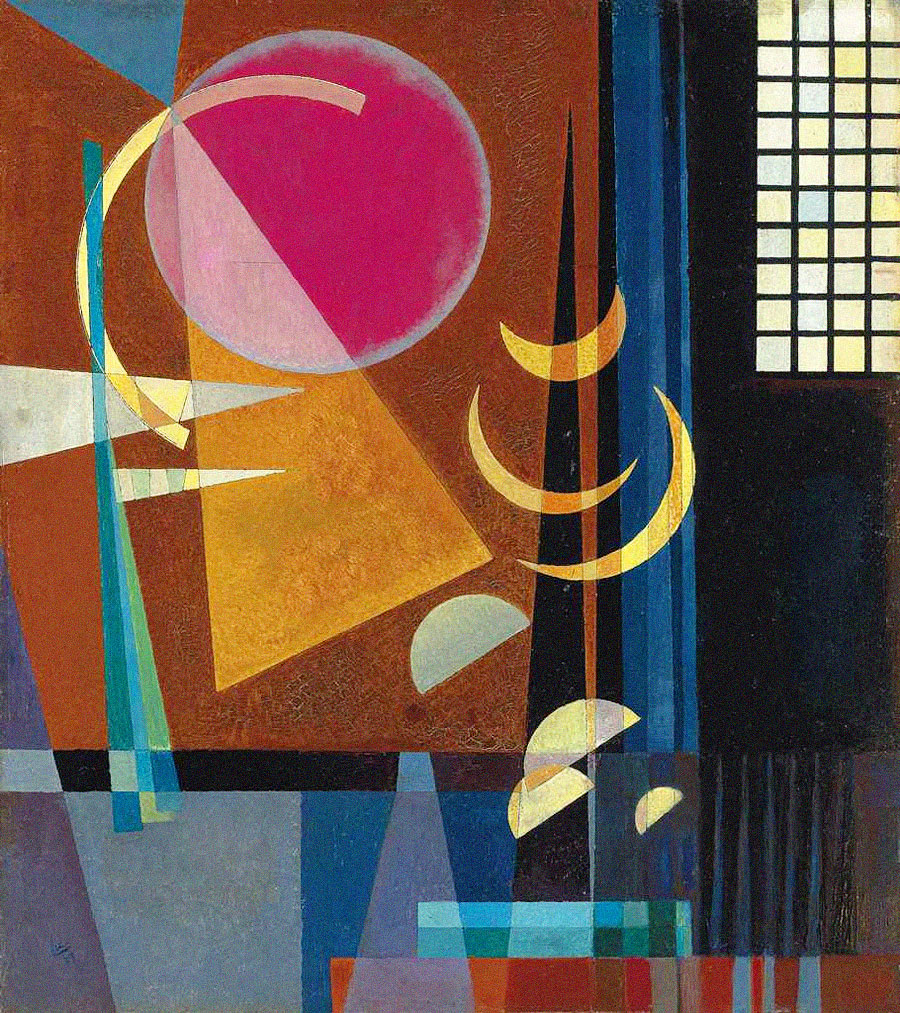
Sharp - Quiet
Scharf - Ruhig
1927
Oil on cardboard
16.5 × 14.6" (42.0 × 37.0 cm)
Private collection
Sharp - Quiet is one of several works from the Bauhaus period in which the triangle-and-circle motif serves as the central compositional element. Kandinsky considered the triangle and the circle to be "the two primary and most strongly contrasting plane figures." Among other things, he taught his students at the Bauhaus to express emotions through the interaction of abstract forms. For example, students were tasked with expressing aggression through a dominant triangle or calmness through a dominant square.
Sharp - Quiet is an excellent example of an ordered composition. Its beauty, dynamic energy, and balance are determined by the stability of the internal space, where triangles, circles, and crescents interact. This is a game of contrasts between the soft, warm, and harmonious colors and the clear, uncompromising geometry.
Sold 21 June 2011 at Christie's, London, for $4.8 million.
Sharp - Quiet is an excellent example of an ordered composition. Its beauty, dynamic energy, and balance are determined by the stability of the internal space, where triangles, circles, and crescents interact. This is a game of contrasts between the soft, warm, and harmonious colors and the clear, uncompromising geometry.
Sold 21 June 2011 at Christie's, London, for $4.8 million.
Be the first to comment
More from 1927


More from Private collection


