Walter Gropius
1883 – 1969
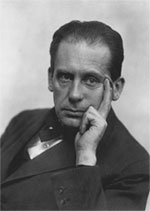
Walter Gropius, 1919
Walter Gropius was born on May 18, 1883 in Berlin. In 1903 he began studying to be an architect in Munich, and then continued his education in the capital city. In 1907 he applied for a job at the company of architect Peter Behrens, where he worked with such renowned architects as Ludwig Mies van der Rohe and Le Corbusier. Three years later, he and his partner Adolf Meyer decided to start their own business in Berlin. Their first projects which immediately began to show a modernist approach were the facade design for a shoe factory in the German town of Alfeld and the Werkbund exhibition hall in Cologne. In 1913, Gropius published his article “The Development of Industrial Buildings”, which had a great influence in professional circles. It is interesting that Gropius could not draw, so throughout his entire study and future career, he had to rely on the assistance of artists.

Marcel Breuer, Gunta Stölzl, Oskar Schlemmer, Wassily Kandinsky and Walter Gropius, 1926
When the war began, Gropius went to the Western Front in the rank of sergeant, where he was seriously wounded and nearly died. During the war, in 1915, Gropius began working at Grand-Ducal Saxon School of Arts and Crafts, and in 1919 assumed the position of its Director. It was that school which Gropius transformed into the famous Bauhaus. The School attracted such teachers as Paul Klee, Johannes Itten, Josef Albers, Herbert Bayer, Laszlo Moholy-Nagy, and Wassily Kandinsky. In the difficult post-war years the need for high-quality, low-cost, simple and functional household products became critical, and Gropius fully devoted himself to it. His most famous creations of Bauhaus period were the F-51 chair and his minimalistic door handles.
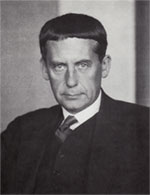
Walter Gropius, 1928
In 1925, for political reasons, the school had to move to Dessau, where designed by Gropius, where the academic and residential buildings designed by Gropius were built according to all the principles of rationalism and functionalism. The training and production were also developed according to these principles, which led to conflicts and the departure of several teachers. Meanwhile, in Germany, for obvious reasons, innovative ideas were becoming increasingly unacceptable and unsafe. In 1928, Gropius moved to Berlin, where he devoted himself to housing construction. In 1932 the Bauhaus was closed. On January 30, 1933, Hitler became Reich Chancellor of Germany and began to implement his ambitious plans.
With the rise of the Nazis, the intelligentsia quickly began to leave Germany. Gropius left for England, where he worked for the Isokon company. In 1937 he received an invitation from the Graduate School of Design at Harvard University and left for the United States.
In 1945, Gropius founded “The Architects Collaborative” (TAC) in Cambridge. Besides him, it included seven young talented architects. TAC created many successful projects around the world and became one of the most influential associations of post-war modernism.


Bauhaus building, Dessau

F-51 chair

Werkbund Exhibition

The Harvard Graduate Center, Cambridge


