

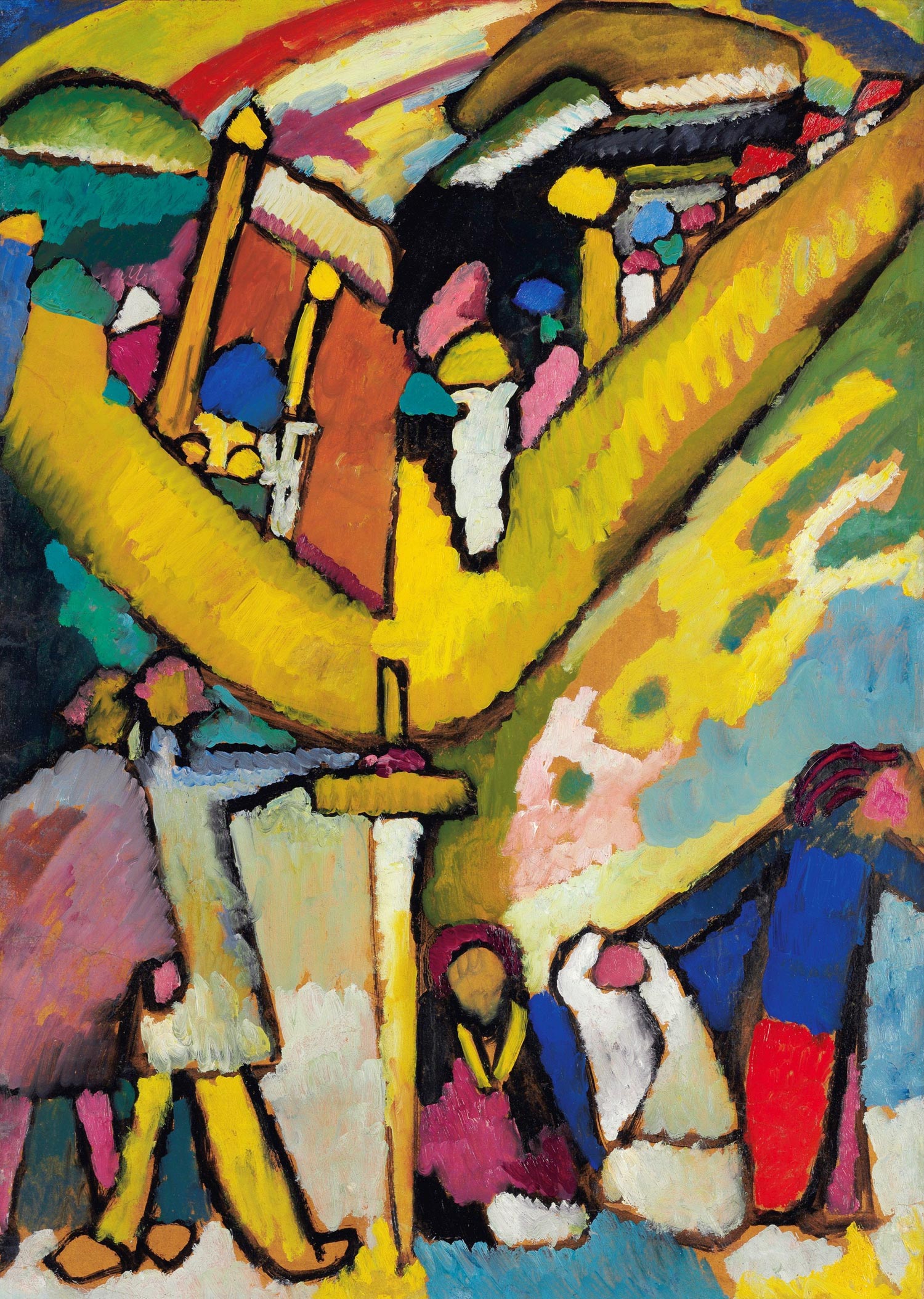
Study for Improvisation 8
Studie für Improvisation 8
1909
38.6 × 27.6" (98.0 × 70.0 cm)
Kandinsky’s series of Improvisations, begun around 1909, along with their preparatory studies, proved crucial in the development of his emerging expressive idiom. These early Improvisations became his primary point of departure: for the first time, he identified the formal devices and imagery that would eventually lead him toward full abstraction. In 1909 alone, he produced six Improvisations and five accompanying studies. Among these, the Study for Improvisation No. 8 stands out as a key work of this series, notable for its exceptional chromatic richness and its imagery, drawn from the early history of the Russian and Ukrainian lands.
In the foreground, two figures appear — one of them gripping a sword thrust into the ground, a gesture that signifies readiness to protect and defend. Pilgrims gather nearby. In the background, the domes of churches rise above the mighty wall that encircles the city. Scholars have interpreted these two central figures as Boris and Gleb, the sons of Vladimir the Great, Prince of Kiev, depicted against the backdrop of the Kyivan Lavra.
Technically, the work belongs to Fauvism, a movement characterized by the use of intense, often jarring color contrasts. Yet Kandinsky does not deploy color merely as a means of heightening expressiveness; rather, he experiments with its symbolic potential, even as he moves toward the more interior, psychological register of Expressionism.
In the foreground, two figures appear — one of them gripping a sword thrust into the ground, a gesture that signifies readiness to protect and defend. Pilgrims gather nearby. In the background, the domes of churches rise above the mighty wall that encircles the city. Scholars have interpreted these two central figures as Boris and Gleb, the sons of Vladimir the Great, Prince of Kiev, depicted against the backdrop of the Kyivan Lavra.
Technically, the work belongs to Fauvism, a movement characterized by the use of intense, often jarring color contrasts. Yet Kandinsky does not deploy color merely as a means of heightening expressiveness; rather, he experiments with its symbolic potential, even as he moves toward the more interior, psychological register of Expressionism.
Be the first to comment
More from 1909


