

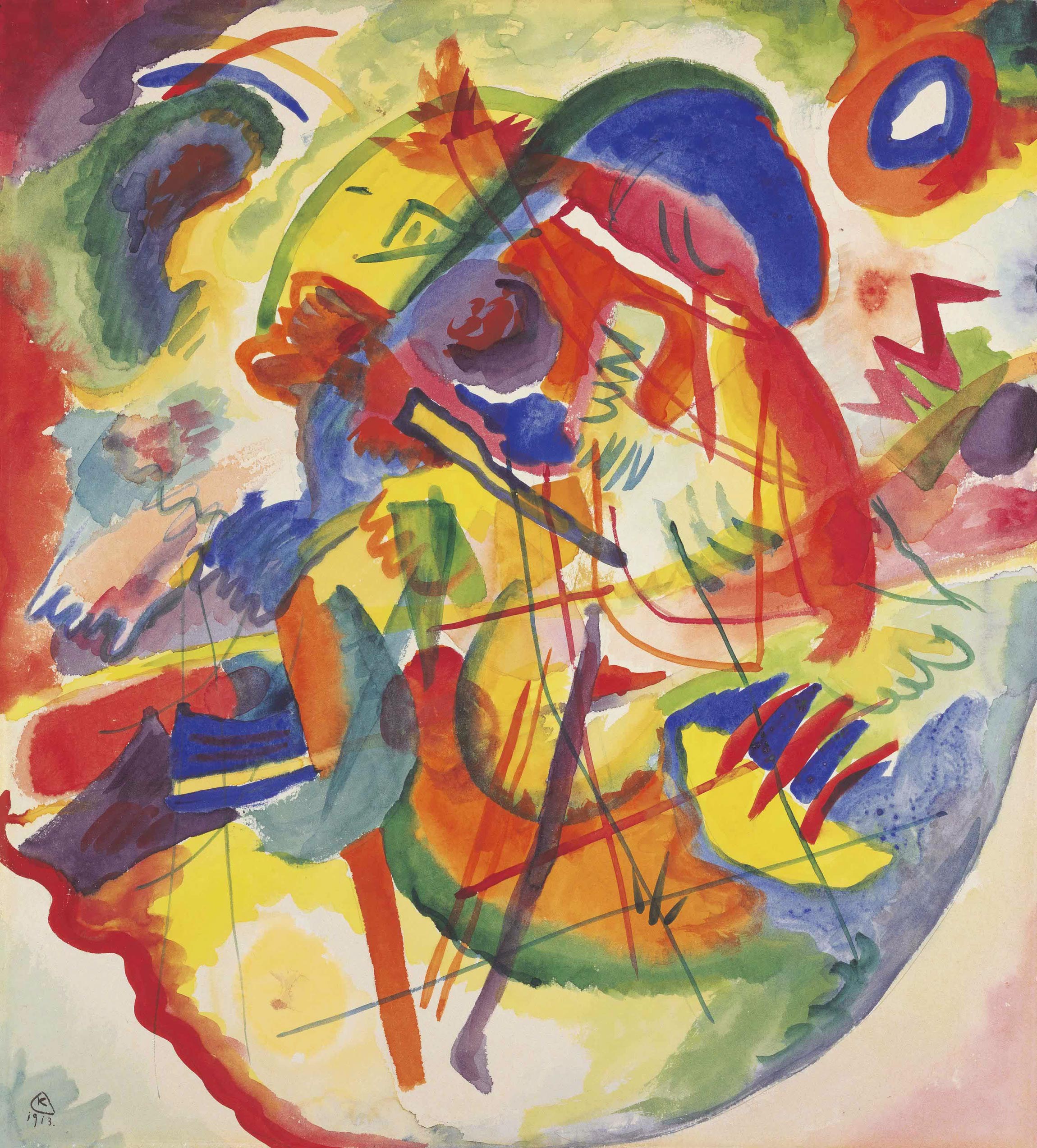
Draft "Improvisation with red and blue ring"
Entwurf zu 'Improvisation mit rot-blauem Ring'
1913
Watercolor on paper
15.7 × 14.2" (40.0 × 36.0 cm)
Private collection
This bright watercolor was a sketch for an oil painting executed in October 1913. While returning from his two-month trip to Moscow via Berlin, Kandinsky captured his impressions of the journey in Improvisation 34. After that, he started working on Improvisation with Red and Blue Ring. This is probably the only existing watercolor sketch, and most likely it was painted just a few days before Kandinsky began working on the canvas. Unfortunately, the final oil painting on canvas has not survived. Today, only a black-and-white photograph of it remains.
One of the first collectors of Kandinsky, Arthur J. Eddy from Chicago, bought the painting in Berlin in 1920. Later, John A. Thwaites, the British Vice-Consul in Chicago, bought it at an auction in 1937 and sent it to Poland. Most likely, the painting was seized and destroyed by the Nazis as an example of "degenerate art."
Comparing this watercolor with other paintings of the same period, we see how Kandinsky moved from spontaneous and vivid primary colors to more deliberate and deep ones. Unlike in most other sketches, Kandinsky abandons the use of contours and works with large masses of pure color.
This work contains the seeds that would soon germinate in one of Kandinsky's most significant works, Composition VII, which, according to Magdalena Dabrowska, is "the culmination of Kandinsky's art in abstract form."
On May 14, 2015, it was sold for $4.53 million at Christie's in New York.
One of the first collectors of Kandinsky, Arthur J. Eddy from Chicago, bought the painting in Berlin in 1920. Later, John A. Thwaites, the British Vice-Consul in Chicago, bought it at an auction in 1937 and sent it to Poland. Most likely, the painting was seized and destroyed by the Nazis as an example of "degenerate art."
Comparing this watercolor with other paintings of the same period, we see how Kandinsky moved from spontaneous and vivid primary colors to more deliberate and deep ones. Unlike in most other sketches, Kandinsky abandons the use of contours and works with large masses of pure color.
This work contains the seeds that would soon germinate in one of Kandinsky's most significant works, Composition VII, which, according to Magdalena Dabrowska, is "the culmination of Kandinsky's art in abstract form."
On May 14, 2015, it was sold for $4.53 million at Christie's in New York.
Be the first to comment
More from 1913


More from Private collection


