


Izo-Narkompros, Moscow 1918
In Berlin, where he and Nina arrived on the eve of the New Year 1922, the conditions were quite hard as well. Political instability after the coup of 1918–1919 and the general post-war economic recession caused ungovernable inflation. The pictures the artist had left in the care of his Berlin dealer, Herwarth Walden, before leaving Russia had dropped significantly in value. Kandinsky had no connections in local art circles, and German art itself had changed a great deal over the years.
Through his friend Paul Klee, the artist came into contact with the Bauhaus, an experimental school whose program he generally supported. In March 1922, architect Walter Gropius, the principal of the school, offered Kandinsky a permanent position as a teacher of wall painting and drawing. Until that time, the Bauhaus's aesthetic ideal had been Expressionism. However, Gropius wanted to add a fresh alternative to the learning process, which was the main reason he hired Kandinsky. The artist from Russia — from the very epicenter of innovation and avant-gardism — came at the right time, of course.

Kandinsky’s Bauhaus identification card, Dessau 1927
Kandinsky's teaching activity at the Bauhaus greatly promoted him as an art theorist. Developing his own theories during his lectures, he also wrote a book about the theory of color and form, which was published under the title Point and Line to Plane in 1926. In it, the artist derives compositional laws that come from the basic forms (points and lines) and are the result of "innermost necessity," which, in his opinion, was to replace obsolete canons defined by the "external" nature.

Wassily and Nina Kandinsky in the Bauhaus “Salon de musique”, 1931 (colorized version)
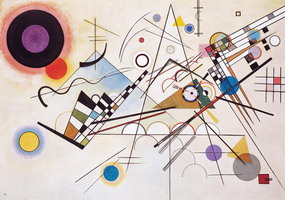
In the 1920s, European artists who considered abstraction a natural direction for further artistic development turned to its geometric language. For the first time, Kandinsky began using geometric elements in his works in Russia. Once he moved to Germany, he combined these trends with the theoretical principles he was developing while teaching at the Bauhaus. Among the main works of this period, the geometric nature of Kandinsky's abstraction evolves and fully unfolds in Composition VIII, painted in 1923. According to the art critic Grohmann, "in this work, geometry becomes a number, but a number transformed into magic."
The Bauhaus and Geometric Abstraction
Kandinsky left Russia for the second time in 1921, leaving behind a boiling post-revolutionary creative environment and the emerging educational system. This experience helped him realize his potential during the first years after the revolution, but political restrictions, the narrow worldview of the powers that be, and harsh living conditions — aggravated by the unceasing civil war and the death of his little son Vsevolod — ultimately forced the artist to leave his homeland. Nevertheless, his participation in exhibitions of Soviet avant-garde artists and his management of the Moscow arts studio definitely paid off.
Izo-Narkompros, Moscow 1918
In Berlin, where he and Nina arrived on the eve of the New Year 1922, the conditions were quite hard as well. Political instability after the coup of 1918–1919 and the general post-war economic recession caused ungovernable inflation. The pictures the artist had left in the care of his Berlin dealer, Herwarth Walden, before leaving Russia had dropped significantly in value. Kandinsky had no connections in local art circles, and German art itself had changed a great deal over the years.
Through his friend Paul Klee, the artist came into contact with the Bauhaus, an experimental school whose program he generally supported. In March 1922, architect Walter Gropius, the principal of the school, offered Kandinsky a permanent position as a teacher of wall painting and drawing. Until that time, the Bauhaus's aesthetic ideal had been Expressionism. However, Gropius wanted to add a fresh alternative to the learning process, which was the main reason he hired Kandinsky. The artist from Russia — from the very epicenter of innovation and avant-gardism — came at the right time, of course.
Kandinsky’s Bauhaus identification card, Dessau 1927
Kandinsky's teaching activity at the Bauhaus greatly promoted him as an art theorist. Developing his own theories during his lectures, he also wrote a book about the theory of color and form, which was published under the title Point and Line to Plane in 1926. In it, the artist derives compositional laws that come from the basic forms (points and lines) and are the result of "innermost necessity," which, in his opinion, was to replace obsolete canons defined by the "external" nature.
Wassily and Nina Kandinsky in the Bauhaus “Salon de musique”, 1931 (colorized version)
In the 1920s, European artists who considered abstraction a natural direction for further artistic development turned to its geometric language. For the first time, Kandinsky began using geometric elements in his works in Russia. Once he moved to Germany, he combined these trends with the theoretical principles he was developing while teaching at the Bauhaus. Among the main works of this period, the geometric nature of Kandinsky's abstraction evolves and fully unfolds in Composition VIII, painted in 1923. According to the art critic Grohmann, "in this work, geometry becomes a number, but a number transformed into magic."



×
![]()
